
The Short Answer
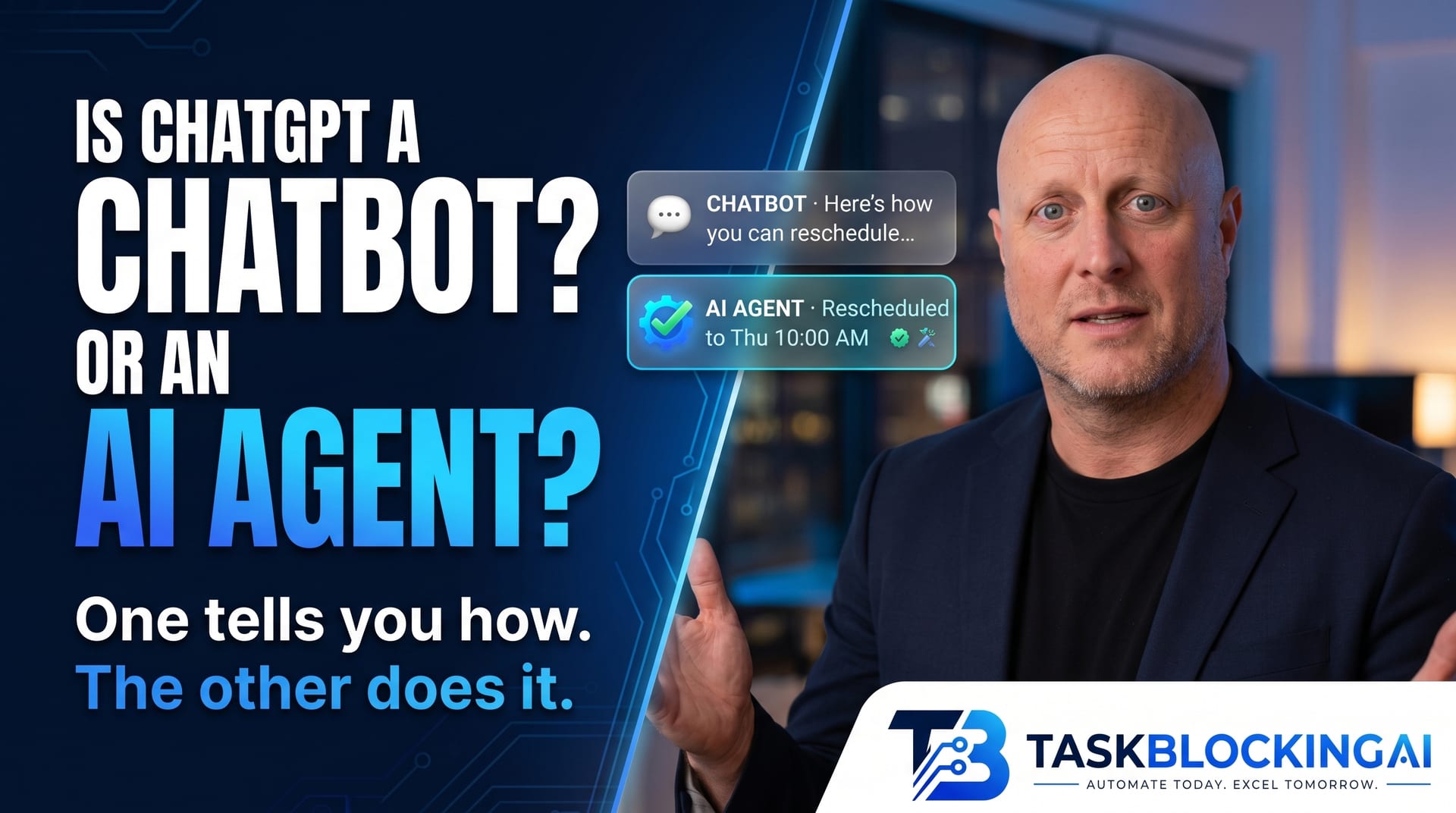
ChatGPT is a chatbot until you let it act.
Ask it a question in a normal chat and it answers, then waits for you. That is a chatbot. Switch on agent mode, or set up one of OpenAI's workspace agents, and the same product can browse websites, fill in forms, update a ticket or send a message on your behalf. That is an AI agent.
So the honest answer to "is ChatGPT a chatbot or an AI agent?" is both, depending on which features are switched on. The name on the box tells you very little.
Siri took the opposite road. Since 2011 it could do things, like set a timer or send a text, but it could not hold a conversation. In September 2026 Apple shipped a new Siri that can. ChatGPT learned to act. Siri learned to talk. They met in the middle.
What actually matters is one question, and it works on every AI product you will be pitched this year: can it change something in another system without you clicking?
Here is what each word means, where ChatGPT and Siri sit today, and how to tell which one your business actually needs.
Four Words Everyone Mixes Up
Most of the confusion comes from four words used as if they meant the same thing. They do not.
| Word | What it is | Example | Can it act without you? |
|---|---|---|---|
| Large language model (LLM) | The engine: a model that predicts text, with no memory or tools of its own | GPT-6, Gemini, Claude | No. It only produces text when something calls it |
| Chatbot | A conversation window wrapped around a model or a script | ChatGPT in a normal chat, the help bubble on a website | No. It answers, then waits for your next message |
| Assistant | A chatbot with tools such as search, files, calendar or code | ChatGPT drafting an email, Siri searching your messages | Sometimes, one step at a time, usually after you confirm |
| AI agent | A system given a goal that chooses its own steps and uses tools to finish the job | ChatGPT agent mode, OpenAI workspace agents, a booking agent on your phone line | Yes. That is the whole point |
The cleanest definition we have found comes from Anthropic, the company behind the Claude models. In its guide to building agents, it separates workflows, "systems where LLMs and tools are orchestrated through predefined code paths," from agents, "systems where LLMs dynamically direct their own processes and tool usage."
In plain English: a workflow follows a route you drew. An agent picks its own route.
Is a Chatbot the Same as ChatGPT?
No. "Chatbot" is the category. ChatGPT is one product in it, and a fairly recent one.
Chatbots are older than the web. ELIZA, written by Joseph Weizenbaum at MIT in 1966, imitated a therapist by turning your sentences back into questions. Through the 2010s, most chatbots on business websites were decision trees: pick a button, get a canned answer. They were chatbots too, just not intelligent ones.
ChatGPT arrived on November 30, 2022 and changed what people picture when they hear the word. Instead of following a script, it ran on a large language model, so it could answer questions nobody had written an answer for.
Today the best-known general-purpose AI chatbots are ChatGPT, Google's Gemini, Anthropic's Claude, Microsoft Copilot and Perplexity, alongside open models such as Meta's Llama that businesses can run themselves. We have reviewed several of them: ChatGPT, Claude, Gemini and Perplexity.
So asking whether "chatbot AI" is the same as ChatGPT is like asking whether a car is the same as a Toyota. ChatGPT is the best-known one. It is not the only one, and most of the chatbots your customers meet on business websites are something else entirely.
Is Siri a Chatbot or AI?
For most of its life, Siri was neither a chatbot nor what people now mean by AI. It was a voice assistant: it matched what you said against a list of commands it knew how to carry out.
That made the old Siri oddly agent-like in one narrow way. "Set a timer for ten minutes" and "text Sam I'm running late" are actions, and Siri could take them. What it could not do was hold a conversation, follow up on its own answer, or handle a question that was not on its list.
| When | What Siri was | Could it hold a conversation? | Could it act? |
|---|---|---|---|
| 2011, iPhone 4S | A voice assistant matching spoken commands | Barely | Yes, for a fixed list of commands |
| Dec 2024, iOS 18.2 | The same Siri, able to pass hard questions to ChatGPT if you allowed it | Only by handing off | Yes, the same fixed list |
| Sept 2026, iOS 27 | Siri AI, rebuilt on large language models | Yes, with saved history | Yes, and it can search your messages, email and calendar to answer |
Apple announced Siri AI at its developer conference in June 2026, saying it can "answer questions related to the content on a user's screen, draw on personal context understanding to search across apps, and go out to the web." A dedicated Siri app keeps your past conversations.
It shipped with iOS 27 on September 14, 2026. CNBC reported that it is a beta you have to opt into, possibly after joining a waitlist, and that Apple is using Google's Gemini to build its own models. At launch it is English-only, and it is not available on iPhones in the EU or in China.
So, is Siri a chatbot or AI? As of this autumn, the new Siri is an AI chatbot and an assistant. Whether it is also an agent depends on what it is allowed to do in your apps, which is exactly the question the rest of this article is about.
Is ChatGPT a Chatbot or an AI Agent?
In its everyday form, ChatGPT is a chatbot. You type, it replies, it waits. Nothing happens outside the chat window unless you copy the answer somewhere yourself.
Three things changed that.
- Tools. Search, file analysis and code made it an assistant. It can look things up and work with your documents, but you still drive each step.
- Agent mode. In July 2025 OpenAI introduced ChatGPT agent, which works "using its own computer." It can navigate websites, fill in forms and log in when you let it. In OpenAI's words, "ChatGPT requests permission before taking actions of consequence."
- Workspace agents. OpenAI now offers workspace agents on its business plans, currently as a research preview. They run on schedules and "take action, like updating tickets, editing documents, or sending messages, without step-by-step guidance." Admins can require a human to approve before they send messages or update records.
OpenAI's launch post for agent mode now carries a note saying it is outdated, and points readers to these newer products. That is how fast the category is moving, and why so much of what you will read about this question is already out of date.
So: ChatGPT is a chatbot by default, an assistant when you give it tools, and an agent when you let it take actions in other systems. Most people use it as a chatbot most of the time.
The One-Question Test
Forget the labels. Ask one question: can it change something in another system without you clicking?
- "Here's how you can reschedule your appointment." It told you how. Chatbot.
- "I've drafted a reply to the customer. Want me to send it?" It prepared the work and waited for you. Assistant.
- "Rescheduled to Thursday at 10:00 AM and sent the confirmation." It changed your calendar and sent a message. Agent.
- "I checked last night's five new leads and added notes to each one in your CRM." It acted on a schedule, without being asked that morning. Agent.
The test works on every product, including the ones in sales pitches. If nothing in your calendar, inbox, CRM or bank account can change without a person clicking, it is not an agent, whatever the brochure says.
AI Agent vs Chatbot: The Autonomy Ladder
It is more useful to think of a ladder than of two boxes. Each rung adds something the AI can do on its own, and something new that can go wrong.
| Rung | What it does | Small-business example | What goes wrong |
|---|---|---|---|
| Scripted bot | Follows a decision tree you wrote | A website menu that answers "What are your opening hours?" | Hits a dead end the moment a question is off-script |
| AI chatbot | Answers in its own words from what it has been given | A website chat that explains your services and prices | Answers confidently when it should not, such as quoting a policy you never wrote |
| Assistant with tools | Reads your data and prepares work for you to approve | Drafts replies from your inbox, summarizes a call | Drafts look finished, so people approve them without reading |
| AI agent | Takes a goal and completes it across systems | Books, reschedules and confirms appointments | A wrong answer becomes a wrong action: a double booking, an email to the wrong client |
| Team of agents | Several agents handing work to each other | One agent qualifies a lead, another books the call, a third sends the follow-up | Mistakes compound, and nobody can say which agent made the call |
Each rung up saves more time. Each rung up also raises the cost of a mistake. Anthropic puts it plainly: "The autonomous nature of agents means higher costs, and the potential for compounding errors." Its advice is to "add multi-step agentic systems only when simpler solutions fall short."
What Changes When a Chatbot Becomes an Agent
When a chatbot gets something wrong, you get a bad answer. When an agent gets something wrong, you get a bad outcome. That is the whole difference, and it changes what you need around it.
- Permissions. An agent should touch only the systems its job needs. A booking agent needs your calendar, not your bank account.
- Approval gates. Sending money, deleting records and messaging a customer for the first time are steps where a person should still say yes. OpenAI builds this into its own agents.
- Logs. Afterward, you should be able to see every action the agent took and why.
- An owner. Somebody in the business is responsible for what the agent does, just as for an employee.
- Protection from hidden instructions. OpenAI warns that "a malicious prompt hidden in a webpage, such as in invisible elements or metadata, could trick the agent into taking unintended actions." A chatbot that reads a bad web page writes a bad answer. An agent that reads one might act on it.
We have written about where a person should still approve the work and how we test an AI assistant before it touches your customers. Both matter far more once the AI can act.
How to Spot a Chatbot Sold as an Agent
"Agent" is the word every AI vendor wants on the box this year. Not all of them have earned it.
In June 2025 Gartner warned about "agent washing": rebranding existing chatbots, assistants and automation tools as agents without real agent capabilities. It estimated that only about 130 of the thousands of vendors selling agentic AI are the real thing. It also predicted that over 40% of agentic AI projects will be canceled by the end of 2027, because of rising costs, unclear value or weak risk controls.
Before you buy anything called an agent, ask five questions.
- What can it change on its own? Ask for a specific system and a specific action. "It books into your calendar" is an answer. "It drives engagement" is not.
- What does it do when it is unsure? A good agent stops and hands off to a person. A bad one guesses.
- Which actions need a human yes? If the answer is "none," walk away.
- Can I see what it did? You should get a log of every action, readable by somebody who is not an engineer.
- What happens when it is wrong? Who notices, how fast, and who fixes it?
If the honest answers are "nothing," "it guesses" and "you can't see," you are buying a chatbot. That might be exactly what you need. Just do not pay agent prices for it.
Which One Does Your Business Actually Need?
Usually less than the pitch suggests. Most small businesses get their fastest win from a well-built chatbot, and add agents only where a task truly needs to be finished, not just answered.
| The job | What it really needs | Rung | Where to start |
|---|---|---|---|
| Answering questions about your services, prices and hours | Accurate answers and a clean handoff to a person | AI chatbot | AI chatbots |
| Booking, rescheduling and confirming appointments | Changes to your calendar and a confirmation sent | AI agent | AI appointment setting |
| Resolving common support issues by email, chat and text | Finishing the job, and passing the rest on with context | AI agent | AI customer service agents |
| Keeping your team on top of tasks, reminders and busywork | Reading inboxes and calendars, preparing work | Assistant | AI employee assistants |
| Answering staff questions about your own processes | Private answers from your own documents | AI chatbot, internal | Internal company GPT |
This is how we approach it at TaskBlocking. We break a workflow into individual blocks of work, then assign each block to an AI agent, an automation, a piece of software or a person. Plenty of blocks never need an agent. Some should always stay with a person.
Frequently Asked Questions
Is ChatGPT a chatbot or an AI agent?
Both. In a normal conversation ChatGPT is a chatbot: it answers and waits. With agent mode or OpenAI's workspace agents switched on, it can take actions in other systems, such as filling in forms, updating tickets or sending messages, which makes it an AI agent. Most people use it as a chatbot most of the time.
Is chatbot AI the same as ChatGPT?
No. "Chatbot" is a category of software that holds a conversation. ChatGPT is one chatbot, made by OpenAI. Gemini, Claude, Copilot and Perplexity are others, and most chatbots on business websites are different products again.
Is Siri a chatbot or AI?
The original Siri was a voice assistant that matched spoken commands. Since iOS 27 in September 2026, Apple's new Siri AI runs on large language models, holds conversations and keeps a history, which makes it an AI chatbot and assistant. It launched as an opt-in beta, in English only.
What are the AI chatbots?
The best-known general-purpose AI chatbots are ChatGPT, Gemini, Claude, Microsoft Copilot and Perplexity. Businesses also use chatbots built for a single job, such as answering questions on their website, which are set up with that business's own prices and policies.
Is an AI agent better than a chatbot?
Not automatically. An agent can finish work that a chatbot can only describe, but its mistakes become actions rather than answers. For answering questions, a good chatbot is cheaper and safer. Use an agent where the task genuinely needs to be completed, and put approvals around anything costly.
Can an AI agent work without supervision?
For narrow, well-tested tasks, much of the time. But it still needs limits on what it can touch, a log of what it did, and a person who approves the steps that are expensive or hard to undo, such as payments or first contact with a customer.
Talking Is Not Doing
A chatbot tells you how to do the work. An agent does it. Most of the confusion about ChatGPT, Siri and every product calling itself an agent disappears once you ask which of those two things it actually does.
ChatGPT can be either. Siri can now talk as well as act. Neither label tells you whether a tool will take work off your plate. The one-question test does.
Identify. Block. Automate.
Identify the work that eats your week. Block it into individual tasks. Give a chatbot the ones that only need answering, and an agent only the ones that need doing, with a person still saying yes where it counts.
If you want to hear what an AI that answers your phone sounds like, talk to our AI receptionist. If you would rather map out your own workflow first, book a free 30-minute call.
Automate Today. Excel Tomorrow.
So: the next time someone sells you an AI agent, ask it one thing. What can it change without you clicking?